e&
2024 - 2026
Accelerating AI adoption using personas
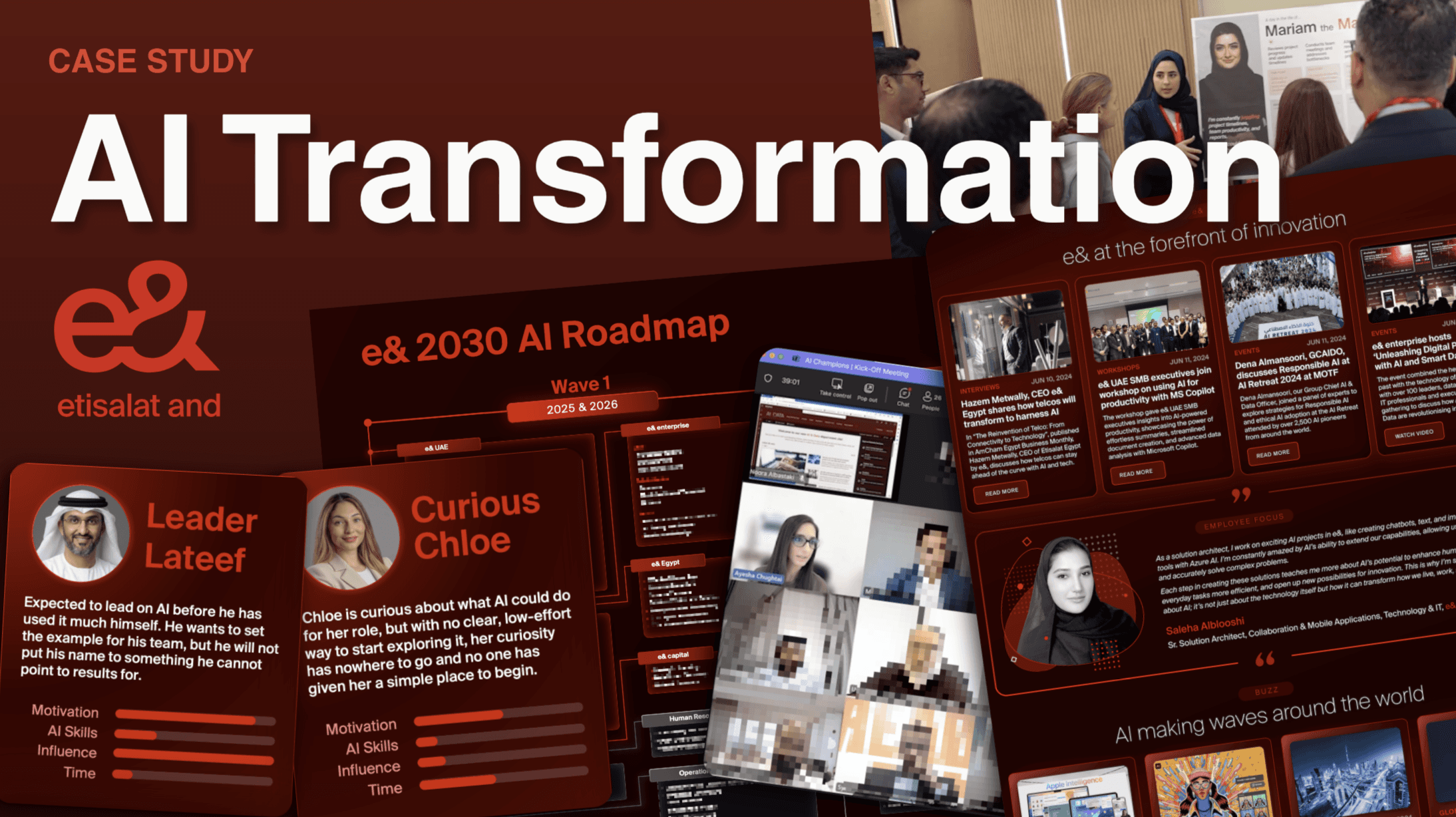
Adoption across a group of 9,000+ people was never going to be one programme. I built personas for the main stakeholder groups at e&, mapped where each one was starting from and what was actually stopping them, then designed a different route in for each.
DISCLAIMER
The personas featured in this case study do not represent real individuals. They were created by me as a design thinking tool to support the strategy described here, and any resemblance to actual people is coincidental. e& has not reviewed, approved, or endorsed these personas or this case study.
This case study reflects work completed during my time at e& and may not represent e&'s current strategy, tools, or processes. Some figures and details have been generalised to protect commercially sensitive information. The framing and interpretation throughout are my own and do not represent an official position of e&.
Where relevant, names, faces, and other identifying content have been blurred, altered, or removed to protect the confidentiality and privacy of individuals and the business. The e& name and logo are trademarks of e&, referenced here only to accurately describe my own contributions.
This case study is shared for portfolio purposes only. It may not be copied, reproduced, or reused without my permission.
Overview
Starting with the people we are designing for
The process
To accelerate AI adoption across e&, I started by identifying the people we needed to bring on the journey with us. Rather than treat the organisation as one audience, I built six personas based on the real stakeholder groups I was working with, from the C-suite through to the wider workforce, so I could design initiatives around what each group actually needed rather than run a single generic programme at everyone.
Meet our 6 e& employee personas
Hover over each to see their quote


Let's dive into each persona to understand them better and then review the unique solution(s) we implemented for each of them.
Innovators and Techies

Why she mattered: Peer proof lands in a way a leadership announcement never does. In my conversations with innovators like Inaya, the results were already there; she had no stage to put them on. Giving her that stage did double duty. It didn't just spread what she knew; it moved her own contribution from doing the work herself to shaping how others did it, which is where her time started to matter more.
Solution
AI Think Tank
I set up an AI think tank to give people like Inaya, already getting results with AI on their own, a formal home to build on that further. Of 200 employees who put themselves forward, 65 were shortlisted for the programme, which opened with a launch event and a keynote from QuantumBlack, McKinsey's AI arm, then moved into breakout groups mapping pain points and where AI could help.
My role
I set up the think tank from scratch, ran the shortlisting process, organised the launch event, secured the keynote speaker, and designed the breakout persona exercise that ran throughout the day. On the day itself, I presented on stage and facilitated the workshop, supported by my team.
Most employees
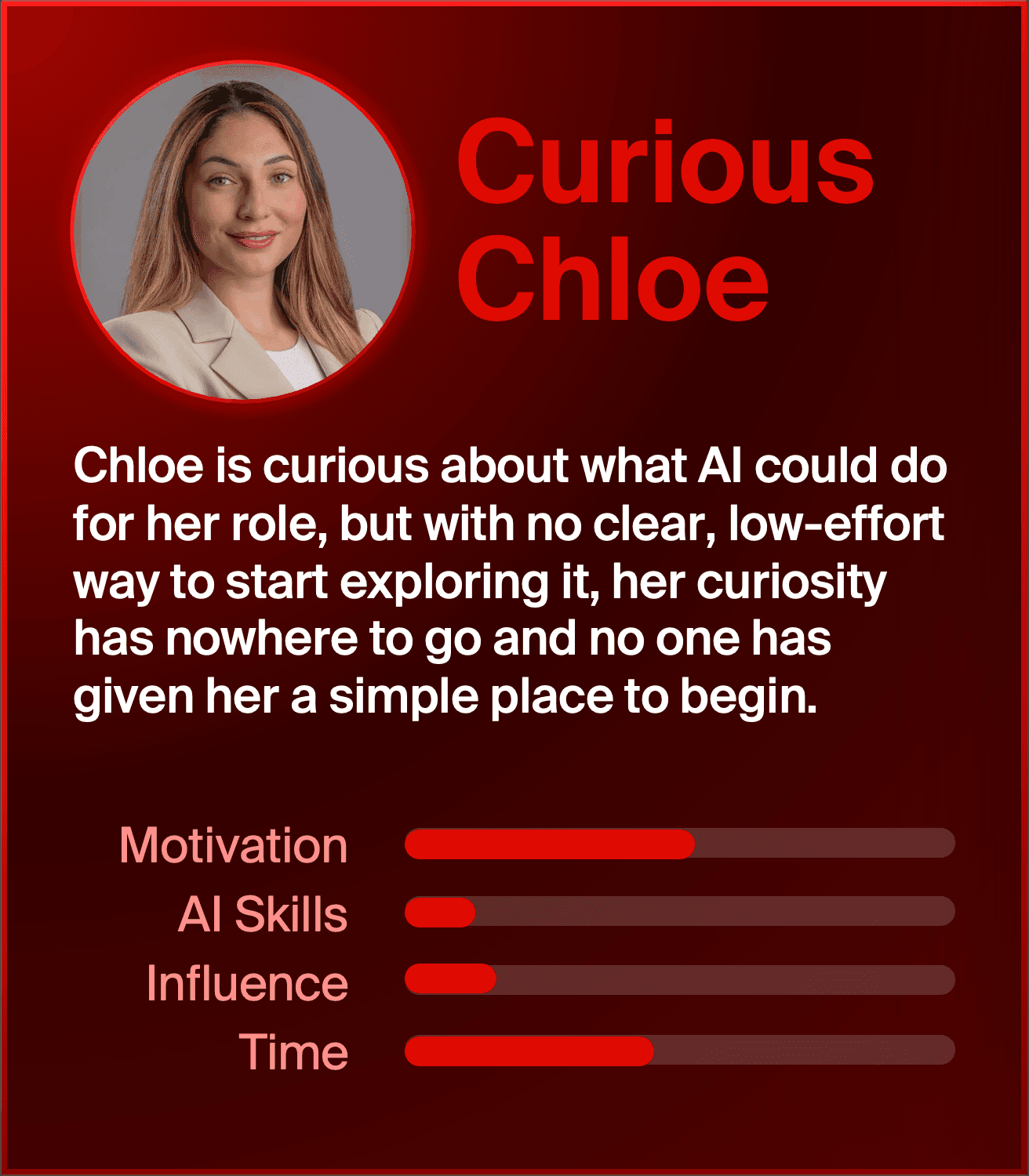
Why she mattered: This is the largest group in the organisation, and the one most at risk of interest fizzling out because there was no easy way in. In my conversations with employees like Chloe, the appetite to learn was already there; what was missing was a low-effort way to act on it, one that could keep pace with how quickly the subject itself kept changing.
Solution #1
All Employee AI-Generated Newsletter Series

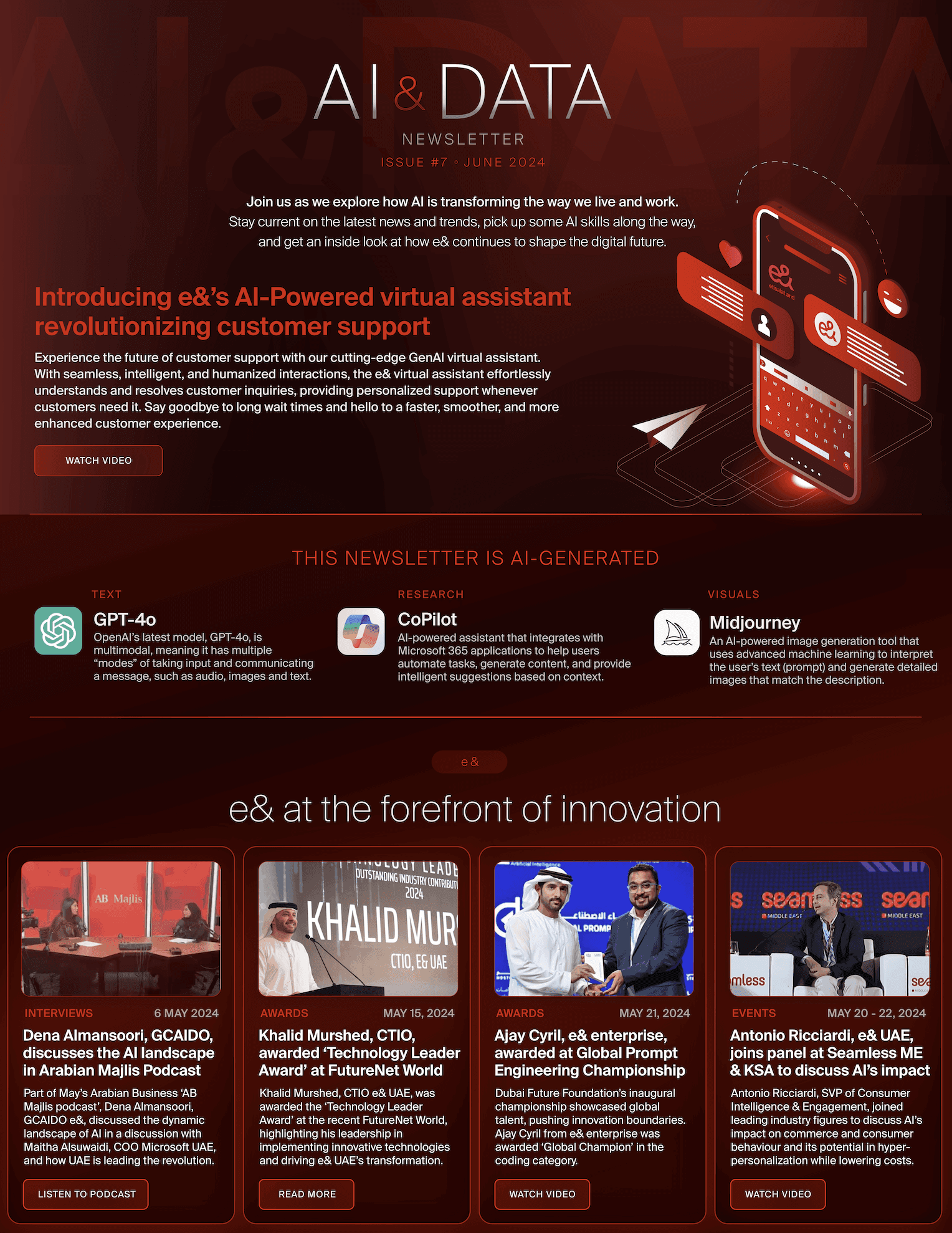


I created an AI-generated newsletter, broken into sections covering current AI trends inside and outside e&, an employee spotlight, and a tool worth trying.
My role
I created the newsletter end to end. I used Midjourney for the thumbnails and Claude to draft captions within the platform's character limits, and I structured every issue into the same sections, trends, an employee spotlight, and a tool to try, so it stayed easy to produce and easy to read. Employees told us they valued learning a little at a time far more than being handed a course to finish.
Solution #2
All Employee SharePoint Site


A SharePoint hub carrying the same content as the newsletter, plus links to learning resources and a repository of e&'s AI and data assets, including the Responsible AI framework.
My role
I built the SharePoint page myself, mirrored the newsletter content onto it so there was always a single place to catch up, and added a running set of learning resources alongside a repository of our AI and data work, including the Responsible AI framework, so people could go deeper whenever they wanted to.
Team Members

Why he mattered: Team-level buy-in decided whether any of this actually worked. In my conversations with people like Ramy, the resistance wasn't to AI itself; it was to handing a careful, high-stakes process to something new without proof that it wouldn't get it wrong. A tool doesn't earn the right to touch a process like this just because it exists; it has to earn trust first.
Solution
e& Assistant: HR and Admin Chatbot


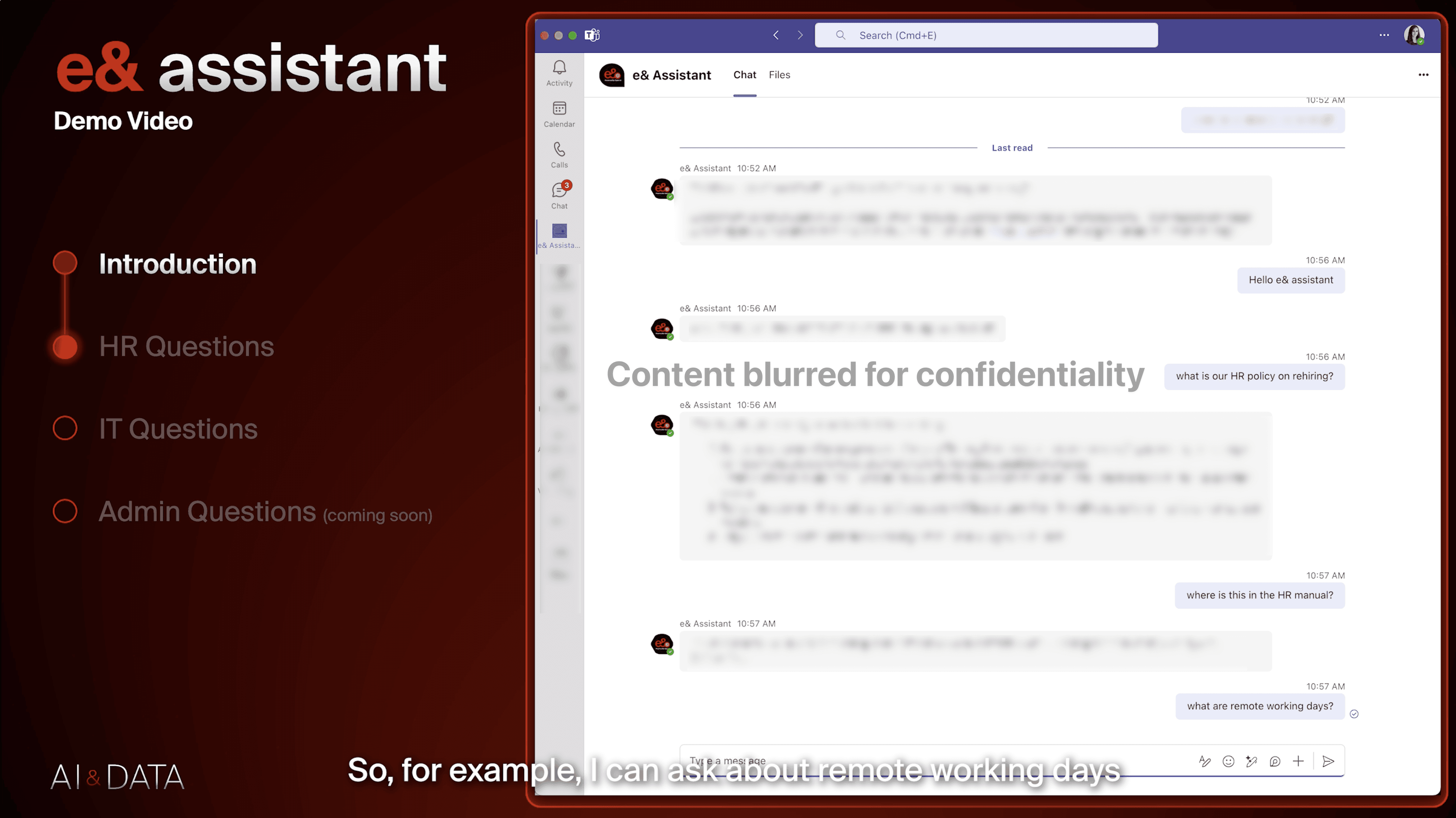
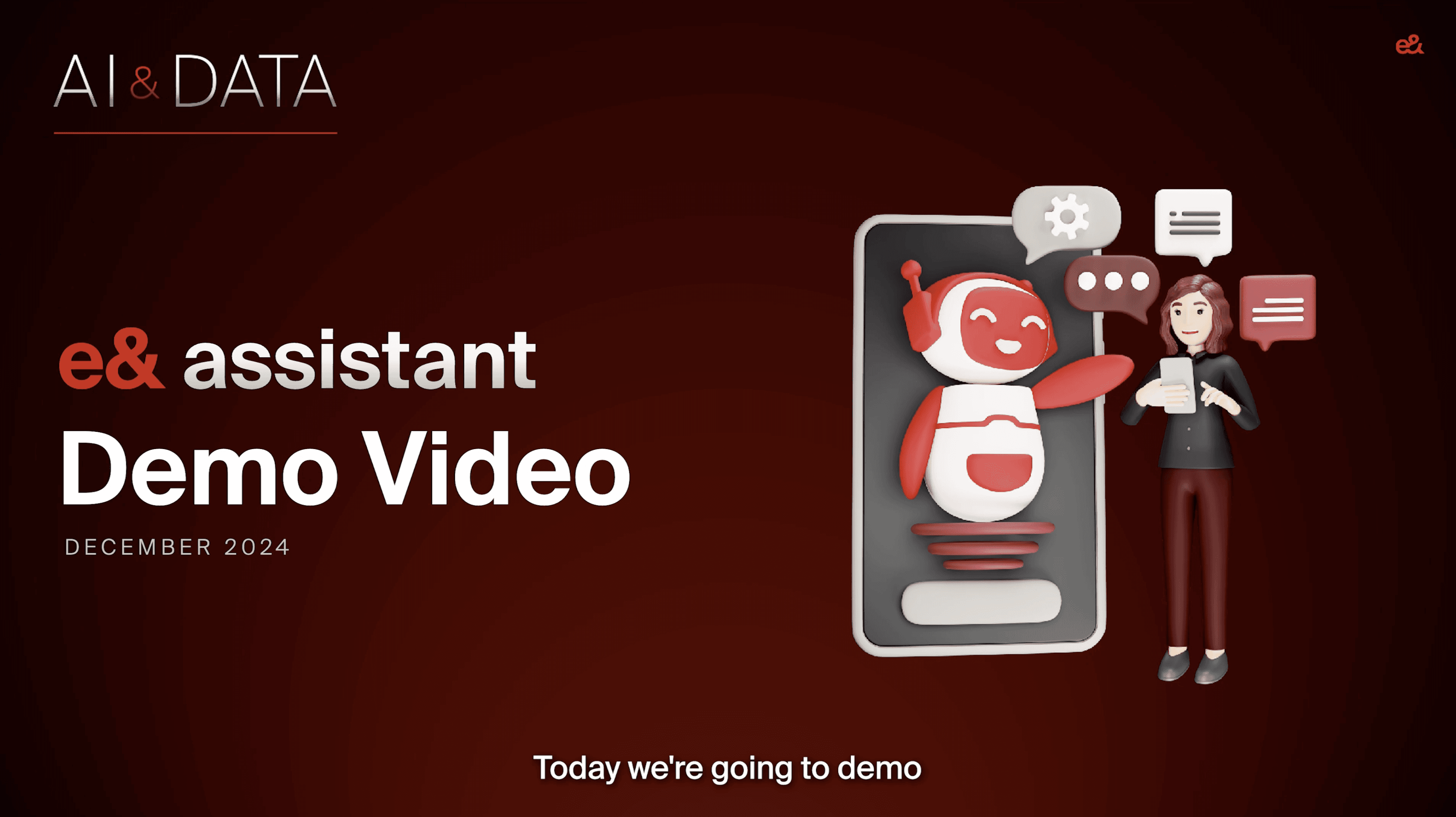
Once the 2030 roadmap identified priority use cases, we built a working prototype of a support bot integrated into Microsoft Teams to answer frequently asked questions for the HR and Admin teams.
My role
Once the tech team built a working prototype in Microsoft Teams, I ran onboarding workshops with separate teams directly in the live tool. I captured the questions and errors they encountered in real use and fed them back to the tech team, which shaped the next round of development before launch.
CXOs and Senior Leaders

Why he mattered: Nothing below the top would move until leadership owned this themselves rather than leaving it to IT. In my conversations with leaders like Lateef, the appetite was already there; what was missing was a real understanding of AI and proof he could point to before he'd put his name to it.
Solution #1
Launch the AIDTC (AI and Disruptive Technologies Council)


My team set up a council chaired by the Group CEO, with all of his direct reports as members, meeting bimonthly. Each session brought in guest speakers from consultancies to walk through current global AI trends, followed by an open discussion among the CXOs about what they were seeing inside and outside the organisation.
My role
I acted as Council Secretary. I organised sessions, shaped the agenda to keep it engaging and aligned with the organisation's AI strategy, took the minutes, and circulated clear next steps to the CXOs ahead of the next meeting.
Solution #2
e&'s 2030 AI Roadmap Workshops


Working with a consultancy, we ran 50+ workshops across every business vertical and support function to map with the CXO's and their heads what each team was already doing in AI, where the real potential sat, and what their pain points were. Those pain points became the basis for a roadmap of prioritised use cases, sequenced across three waves, wave one covering the first two years, waves two and three carrying through to 2030, each with an estimated financial impact attached.
My role
I partnered with the consultancy to design and facilitate the workshops, coordinated with stakeholders throughout, and built the key presentation slides. From those sessions, I helped shape the final roadmap by translating the pain points we heard into a prioritised, wave-based structure with attached financial impact.
AI Champions
Persona #5: Ready Rashid

Why he mattered: A strategy sets direction from the top, but someone still has to keep it moving inside each team, day to day, closing the gap between a decision made in a council meeting and a change that actually happens on the ground. In my conversations with people like Rashid, that was exactly the role they wanted: real ownership of their corner of it and accountability for the outcome, not just a mention at a town hall.
Solution
AI Champions Programme

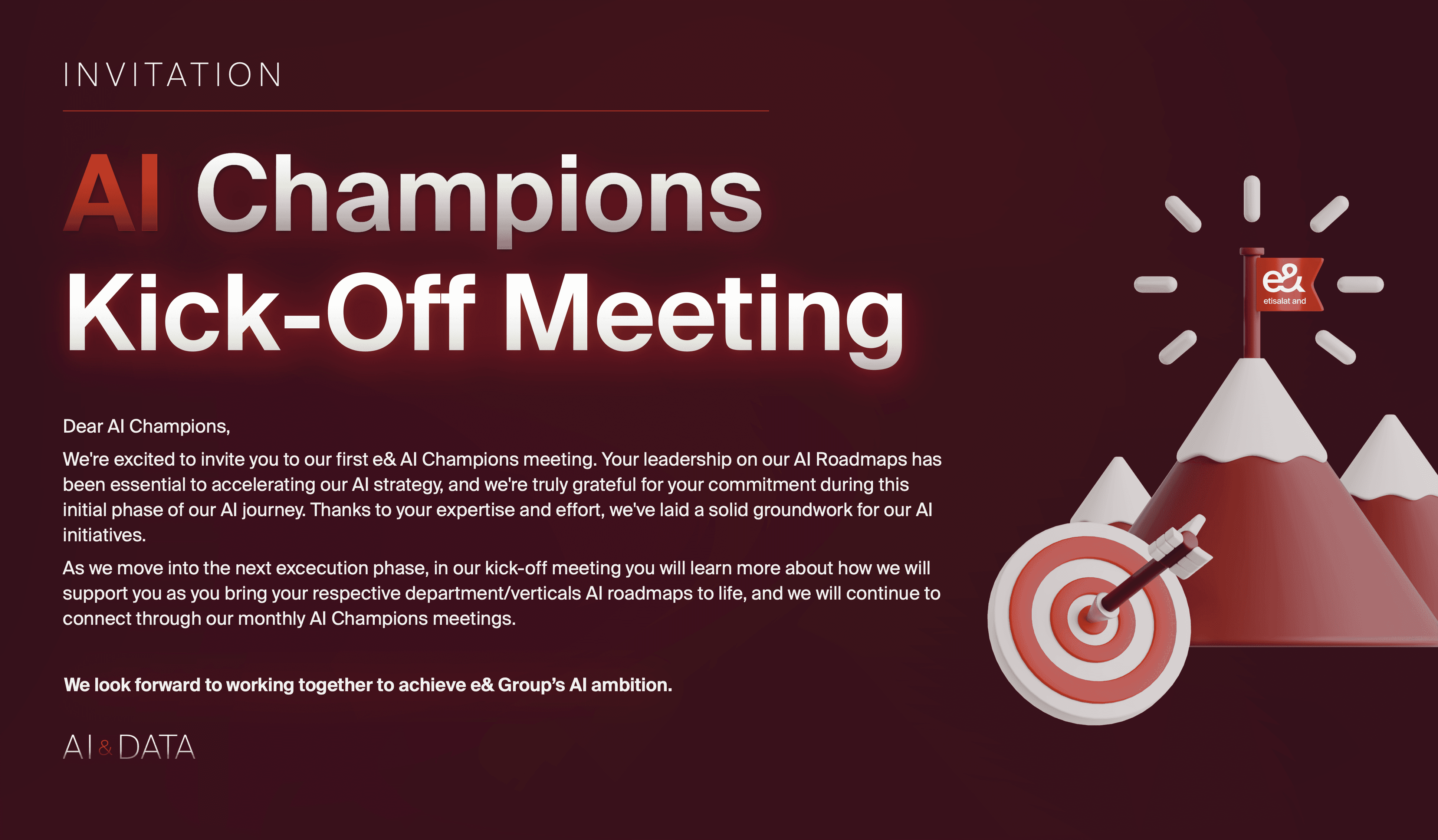
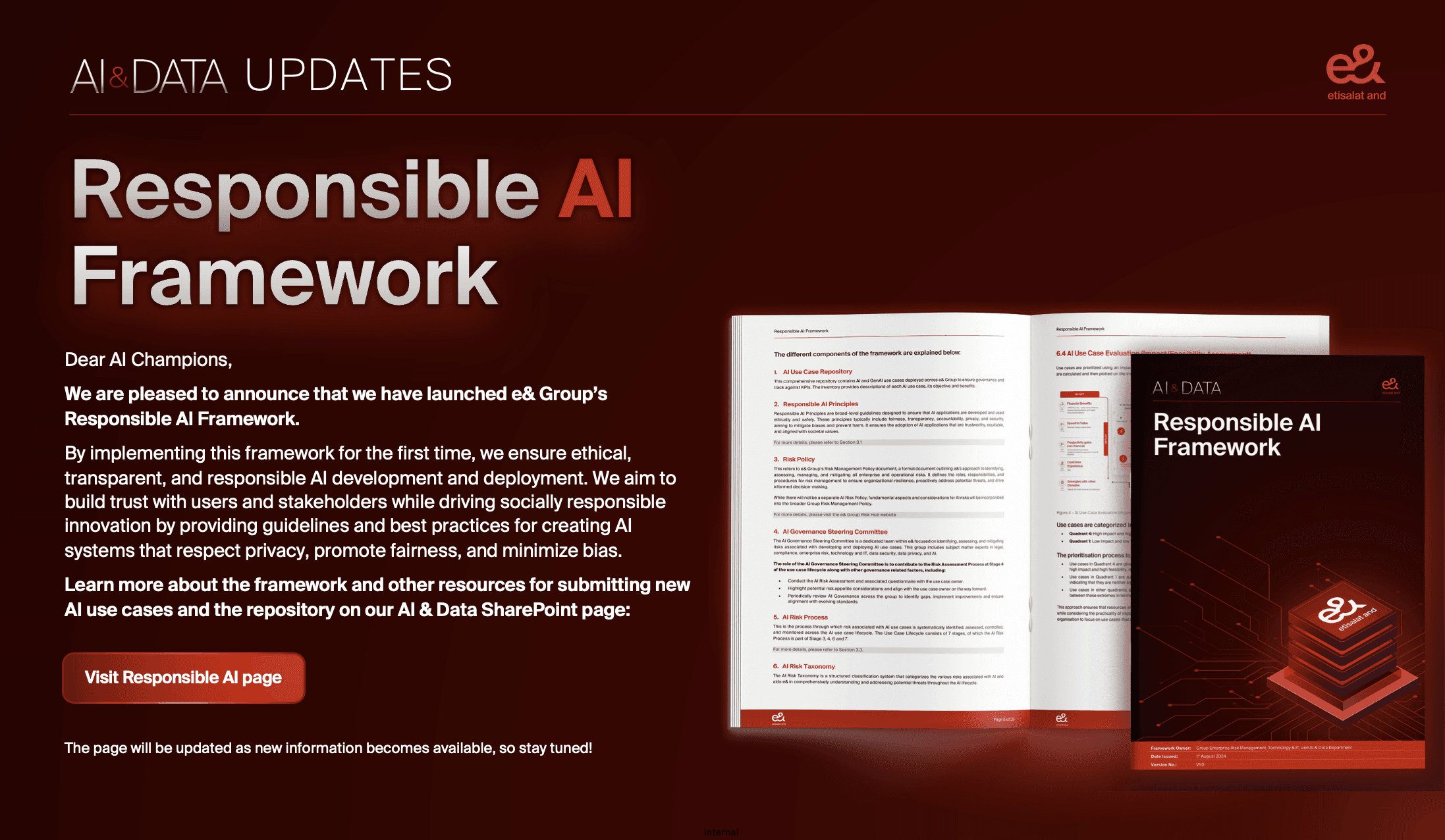
Within each vertical and support function, we identified a tech or strategy expert to act as that team's AI champion, responsible for the roadmap staying on track and for communication between their team and the CXOs.
My role
I designed the champion model itself, identifying a tech or strategy lead within each team, people like Rashid, and defining what the role carried: ownership of that team's roadmap, a direct line to the CXOs, and real autonomy balanced against real accountability for hitting their objectives.
External Partners and Stakeholders

Why she mattered: Internal adoption is only half the picture. In conversations with board members and investors like Sara, what mattered wasn't what was happening inside the organisation; it was what was visible from outside it.
Solution #1
Publish whitepaper on AI
A whitepaper showcasing how e& was positioning itself at the forefront of AI, released in partnership with the Chief Technology and Information Officer.

My role
I worked directly with the Chief Technology and Information Officer to shape the positioning, then coordinated with the branding, PR, and agency teams to design, generate the AI images, compile and produce the final white paper.
Solution 2
Strategic Partnerships
A portfolio of external AI partnerships that gave the organisation validation beyond its own messaging.



My role
- AI Nation Afaaq: Worked on the creative campaign with the AWS team including social post design, website UI and content.
- IBM watsonx: Worked closely with the implementation teams internally for deployment and adoption of the tool.
- Nokia Bell Labs: worked closely with the partnerships team to coordinate the press release, the GITEX award, and the ongoing joint projects.
- UNDP: worked on the presentation for the platform, presented at the UN in New York.
Wrap up
Bringing it all together
These six tracks ran in parallel, reaching over 9,000 employees through the entry point that actually made sense for each of them. None of it would have worked without starting from real conversations rather than assumption, that human-centric approach is what let six different initiatives land where one generic rollout would have failed.
Why a people-centric approach worked
Reach across every level of the organisation.
Over 9,000 employees engaged, from the CEO's direct reports down to individual employees, each through the entry point that direct research into their needs pointed to, rather than one blanket programme.
A working roadmap through to 2030.
Built from workshops that asked each business vertical what their actual pain points were, not from a generic AI wishlist, and turned into a prioritised, three-wave roadmap with financial impact attached.
Adoption built on proof, not announcements.
The procurement chatbot and the AI think tank were both shaped by the people who would actually use them, tested against real scepticism and real expertise before launch, rather than handed down finished.
External validation
The internal work led to a formal R&D partnership with Nokia Bell Labs and a GITEX award, external recognition built on a genuine, research-led adoption story rather than a marketing claim.cating, copy and paste the component into your Framer project. Then edit the questions, answers, styles, and animations as needed.