Department of Health
2021
Designing a medical education platform for
Abu Dhabi's healthcare community
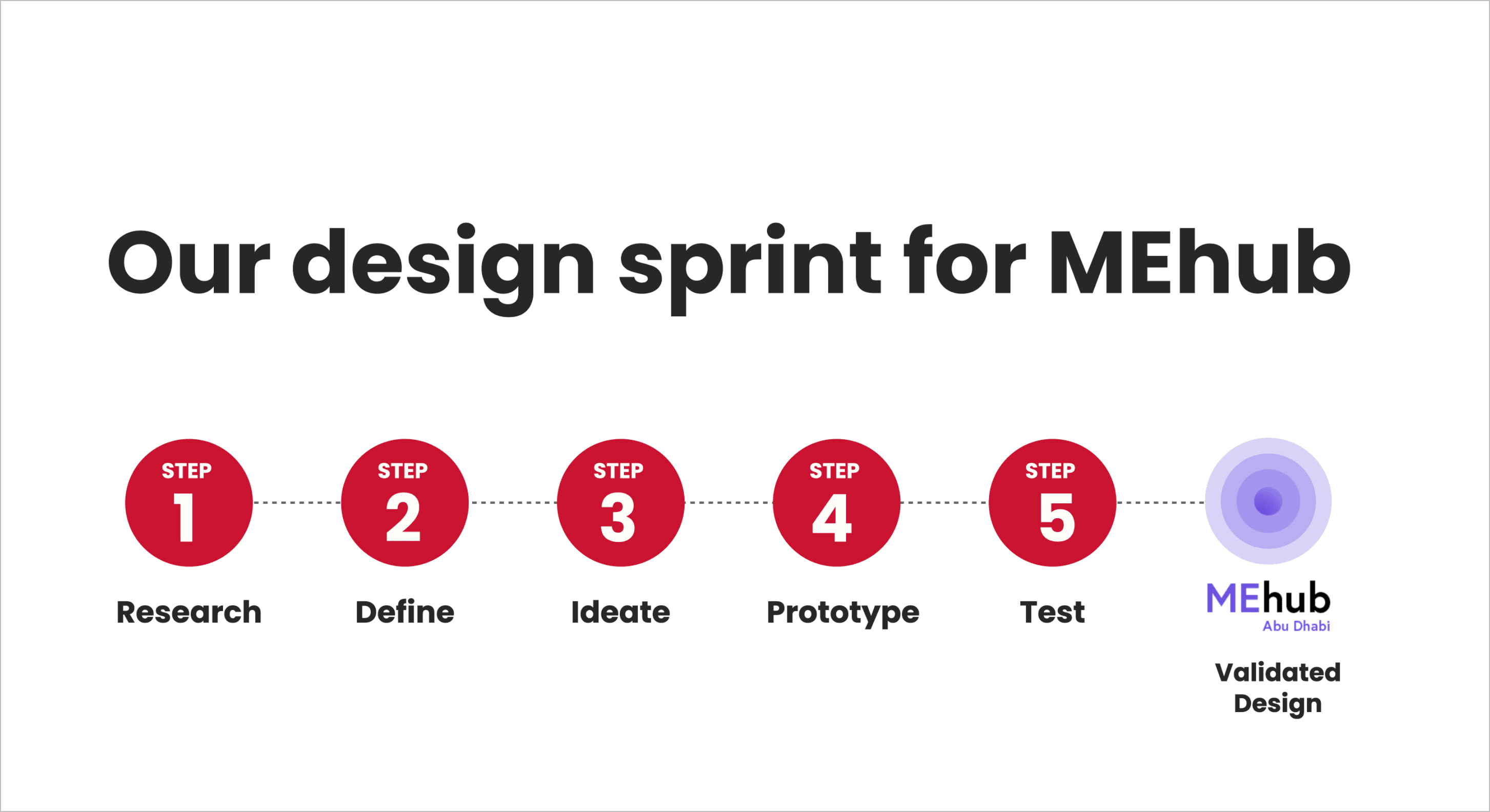
Working with the CoCreation Lab in Etisalat Digital, I collaborated on a five-step design sprint with an Abu Dhabi government health entity to create MEhub, a single platform that brings health professionals, CME providers, and the regulator together, from identifying a learning need through to licence renewal.

DISCLAIMER
Some confidential sections of this case study have been hidden to protect the client.
This case study covers an engagement between Etisalat Digital and a health entity in Abu Dhabi. The work and its outcomes are confidential, and this page is not published publicly. The framing and interpretation throughout are my own and do not represent an official position of Etisalat Digital or the client.
Where relevant, names, faces, and other identifying content have been blurred, altered, or removed to protect the confidentiality and privacy of individuals and the organisations involved.
This case study is shared for portfolio purposes only. It may not be copied, reproduced, or reused without my permission.
The Challenge
From Scattered to Connected
Abu Dhabi's Department of Health (DOH) needed a better way to manage continuing medical education (CME). Health professionals, CME providers, and DOH were each handling their own part of the process separately: designing and accrediting programmes, finding and attending them, collecting certificates, and using those credits to renew a medical licence. Nothing connected, and most of it was manual.
MEhub was the answer: one platform bringing all three groups together, from the moment a learning need is identified through to licence renewal.
I delivered this as a five-step design sprint through the Co-Creation Lab at Etisalat Digital, working side by side with the DOH team. I designed and facilitated the workshops, ran the interviews and testing sessions, and designed the platform's information architecture, journey map, and interface.
Approach
Following the Design Thinking Methodology
Medical education in Abu Dhabi involves a regulator, dozens of providers, and thousands of practitioners, each with different needs and a different part of the process. Design thinking kept all three in view, so every feature on MEhub had to earn its place with the people who would actually use it.
PHASE 01
Research
Desk research
We framed the research around three questions: who are we designing for, what problem are we solving, and what does good look like elsewhere? Desk research covered medical education bodies (ACGME, the Royal College of Physicians and Surgeons of Canada and its CanMEDS framework, and ACP Online) and learning platforms (Coursera, edX, LinkedIn Learning, and PebblePad). We then ran three sets of interviews.

Interviews
Stakeholder Interviews DOH leaders who set medical education policy and oversee accreditation. CME Provider Interviews Education teams at Imperial College, CCAD, Al Ain Hospital, and a MENA conference organiser. Health Professional Interviews A physician, nurse, paediatrician, and surgeon from CCAD, SSMC, and SKMC.

Why it mattered: Each group saw the same process from a completely different angle. Hearing all three first-hand stopped us designing for the regulator alone.
My role
I designed the research approach and interview guides, ran the interviews, and synthesised the findings into material for the discovery workshop.
PHASE 02
Define the Problem
Discovery Workshop
We ran a discovery workshop with DOH built around a ten-stage learning journey: Qualifying, Designing, Accrediting, Marketing, Choosing, Transacting, Learning, Certifying, Portfolio Enhancing, and Licensing. Each activity looked at that journey through the eyes of health professionals, CME providers, and DOH.

Guiding Principles
From there, I designed the MEhub framework on CanMEDS and shaped it into six guiding principles: Academic: Lifelong learning and knowledge sharing. Leader: Access to the latest clinical practice. Health Advocate: Research that feeds Abu Dhabi's knowledge economy. Team Player: Collaboration across disciplines and organisations. Trusted: A safe space for HPs, providers, and DOH to work together. Professional: A place to showcase work and connect with experts.

Why it mattered: The principles gave everyone a shared yardstick. They went on to shape the information architecture, the end-to-end journey, and the interface itself.
My role
I designed and facilitated all three workshop activities, and created the framework and guiding principles from what came out of them.
PHASE 03
Ideate on solutions and then prioritise
Ideation
In an ideation and prioritisation workshop with DOH, we asked one question: what could MEhub offer that would solve the challenges we had found? We generated as many ideas as possible, mapped them into an information architecture for health professionals, then ranked each feature from Priority 1 to 5 by its value to users.

Prioritisation
In a workshop, we prioritised features with the leadership: Catalogue Flipboard, micro and macro views, and a map view. Portfolio Networking, achievement badges, and a customised CV and CME credit exporter. Learning Face-to-face, live online, and self-paced online programmes. Programme Creation Project management, assessment creation, and presentation and video tools. Analytics Data visualisation, trends and projections, and a report generator. Common Features Help and support, account settings, and user profiles.

Why it mattered: Ranking by value to users, rather than by what was easiest to build, meant the MVP would solve real problems from day one.
My role
I designed and facilitated the workshop and built the information architecture live with the DOH team.
PHASE 04
Prototype
Prototype
I designed wireframes from the prioritised features, then the full interface. One example is the accreditation flow, where a provider can see DOH's comments against each section of their application and resubmit evidence in the same place.

Why it mattered: A clickable prototype gave users something real to react to, well before any development budget was spent.
My role
I designed the wireframes, interface, and interactive prototypes.
PHASE 05
Test the prototype
Testing Sessions
We ran one-on-one sessions over Microsoft Teams, walking CME providers and health professionals through the prototype and capturing their feedback. We then made changes based on what they told us. The left navigation, for example, was redesigned to be brighter and larger after testers said it felt hidden.

User Feedback
"This is going to be so useful to everyone and gives us so much more opportunities to learn and even connect all from one place." Paediatric Specialist, SKMC "Thank you so much for taking our feedback last time to define this platform. It is something we all need and have been wanting this for so long!" Health Professional "Not sure why it is called 'Course', there are many different types. Better to label it 'CME Programs'." Education Head, Conference Provider

Why it mattered: Several testers had also been part of the research. Seeing their own input reflected back built trust in the platform before it even existed.
My role
I facilitated the testing sessions along with my team, synthesised the feedback, and made the design changes.
FINAL DELIVERABLES
The Validated Design
The sprint ended with a design DOH could take into development with confidence.
12 Key Features
Design Wizard, Accreditation, Marketing, Analytics, Catalogue, Payments, Online Courses, Interactive Classes, Certifications, Community, Portfolio, and Licence Renewal.

End-to-end Journey Map
All ten stages mapped for DOH, providers, and health professionals, down to automated licence renewal reminders for DOH.

Responsive Design
Designed for desktop, tablet, and mobile from a single build, for a faster route to market.

Phased Roadmap
An MVP responsive website first, followed around six months later by a hybrid mobile app, payments, livestream learning, community features, and AI personalisation, with each release shaped by usage data.

WRAP UP
A platform designed for the end users
MEhub worked because it started with the people who would use it. A regulator, a provider, and a practitioner all touch the same licence renewal, but they experience it in completely different ways. Interviewing each group, bringing their challenges into the workshops, and testing the prototype with them is what turned three disconnected processes into one platform. The design that came out of the sprint was validated by its users before a single line of code was written.
DISCLAIMER
Some confidential sections of this case study have been hidden to protect the client.
This case study covers an engagement between Etisalat Digital and a health entity in Abu Dhabi. The work and its outcomes are confidential, and this page is not published publicly. The framing and interpretation throughout are my own and do not represent an official position of Etisalat Digital or the client.
Where relevant, names, faces, and other identifying content have been blurred, altered, or removed to protect the confidentiality and privacy of individuals and the organisations involved.
This case study is shared for portfolio purposes only. It may not be copied, reproduced, or reused without my permission.