Etisalat
2021 - 2022
Reimagining recruitment and onboarding for new joiners
in 2021 I moved to the HR team as Head of Employee Experience. The brief was to bring the same customer centricity we'd already built for customers and apply it to our employees, essentially to put people at the heart of the transformation rather than treat employee experience as an afterthought.

Laying the groundwork
Understanding the Current State
What we did: I set up an all-HR workshop with around 80 attendees across teams, walking through the employee lifecycle end to end. Each team told us what currently happened in their part of the process and where the pain points were. We also built personas into the workshop itself, so HR teams could step out of their own function for a moment and think from the employee's point of view, what actually motivates and drives someone at each stage, rather than defaulting to how HR already saw the process.

The full employee lifecycle with the post-its from the workshop, added by the participants

The full employee lifecycle with the post-its from the workshop, added by the participants
Workshop at a glance:
80 attendees
Attended over Microsoft Teams from across HR teams, covering the employee lifecycle end to end.
Personas exercise
Helped HR teams step outside their own function and think like an employee.
Outcome
Recruitment and onboarding identified as the priority stage to fix first.
Why it mattered: You can't prioritise a sprint on a hunch. Getting the whole of HR into one room, mapping the full lifecycle together, and forcing the conversation to centre on the employee rather than the process, is what surfaced recruitment and onboarding as the stage doing the most damage, not because it was the loudest complaint, but because it was where the evidence actually pointed.
My role
I designed and ran the workshop, including the persona exercise, and synthesised what came out of it into the case for prioritising recruitment and onboarding.
Kick-off
Leading with Design Thinking to revamp the experience
With recruitment and onboarding identified as the priority, I led the six-phase sprint that followed end to end. Every workshop activity, diagram, and piece of research synthesis came out of my own design, and I taught the team of seven as we went, since design thinking wasn't a method most of them had run before. My other role throughout was keeping the whole thing on track and compiling everything the sprint produced into what follows.

PHASE 01
Research
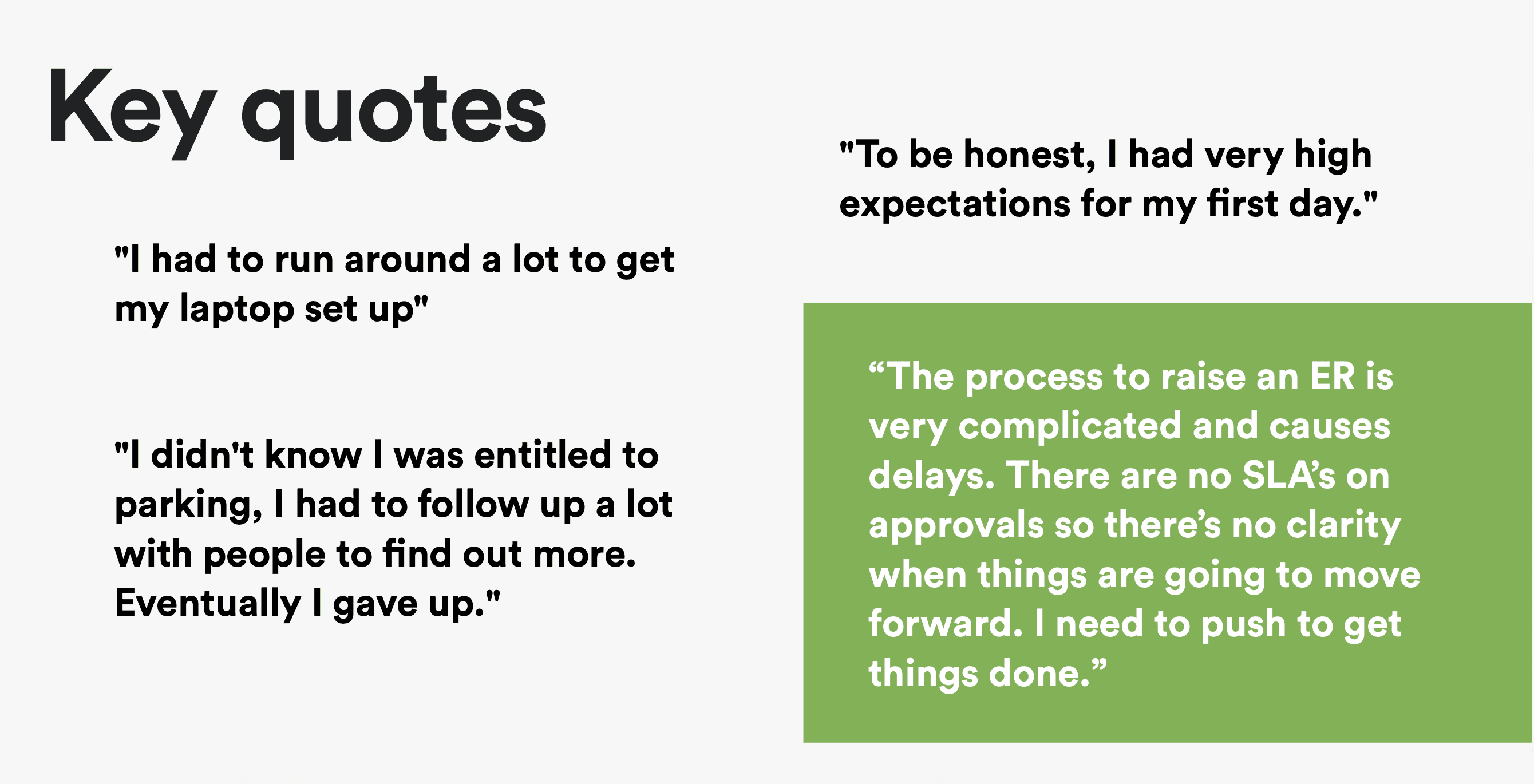
What we did: We opened with desk research benchmarking recruitment and onboarding data externally, then ran employee surveys and one-on-one interviews with new joiners, alongside interviews with HR stakeholders across recruitment, HR business partnering, and rewards.

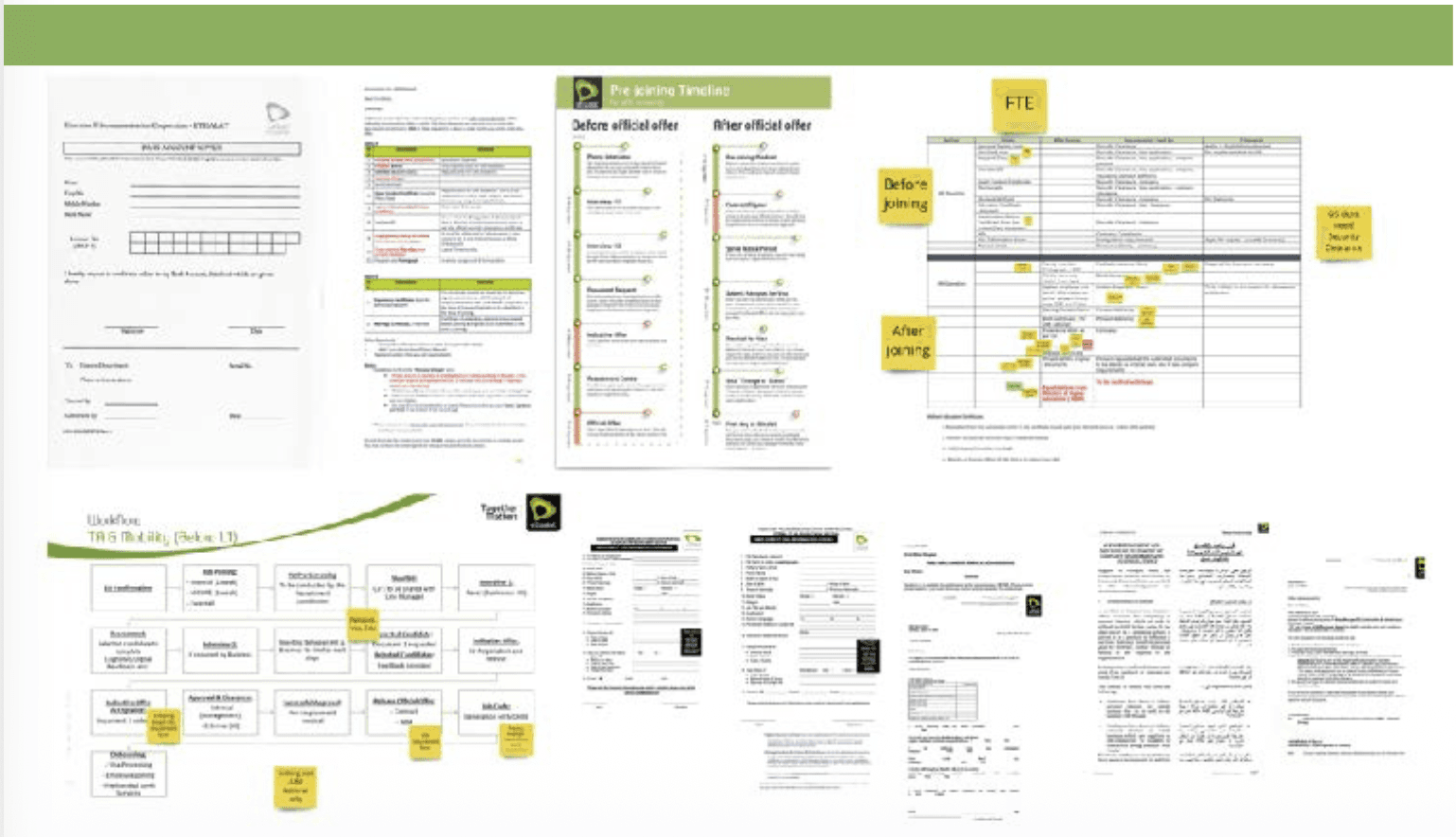
Candidates were asked for multiple documents at various stages causing confusion and frustration

There were many current internal approvals with multiple departments that could be removed or streamlined.
Why it mattered: Before we touched a single solution, the problem needed to be understood properly. Time spent here is what stopped the sprint from jumping straight to ideas that felt good but didn't address what candidates and new joiners were actually living through, as well as the hurdles that HR faced.
My role
I designed the research approach and the interview guide, taught the team how to run the stakeholder sessions, and compiled everything we gathered into the findings above.
PHASE 02
Define the Problem
What we did: We mapped the entire current journey end to end, from a candidate first seeing a role through to completing probation, covering what the candidate experiences, what happens behind the scenes at Etisalat for both full-time and outsourced hires, which teams are involved at each step, and where the pain points sit. Alongside it, we mapped the current internal approvals process, which ran through far more departments than it needed to, and looked closely at what documents candidates were being asked for and when.
Going back through what we'd heard from both HR teams and new joiners in the Phase 1 interviews, five pain points came up again and again:

Why it mattered: This phase had one job, make sure nothing got missed before we started designing solutions. Identifying recurring themes and patterns helped us to focus when we were ideating, and ensured we were solving the right problem.
My role
I designed the current journey map in collaboration with the team and the approvals map, and led the synthesis session that pulled our research into the five themes above.
PHASE 03
Ideate on solutions
What we did: We started by mapping the three solution themes, simplify, communicate, and delight, directly onto the current journey stage by stage, so we had a clear starting structure for where each type of fix needed to apply.

Current journey with pain points and potential solutions to solve pain points
Workshop #1: How Might We…
From there, the first workshop used 'How Might We' prompts, built directly from the pain points at each stage, to generate specific ideas within that structure. Every idea, good or half-formed, went up.

Current journey with pain points and potential solutions to solve pain points
Concept Cards
We turned the strongest ideas into concept cards, fleshing each one out with a rough read on how complex it would be to build.

Workshop #2: Prioritization with Concept Cards
In a second workshop, we plotted every concept on a value versus effort matrix, sorting them into quick wins, next year's work, things to do if there was time, and things to leave alone.

Why it mattered: Open ideation generates dozens of good ideas and no way to tell which ones are worth building. The value versus effort matrix is what turned a long list into an actual shortlist, and gave HR stakeholders a shared, visual reason to agree on what came first.
My role
I designed both workshops, the activities, the prompts, the concept card format, and the prioritisation exercise, and facilitated each one, teaching the team the method as we ran it.
PHASE 04
Prototype & Test
What we did: We went back to employees before committing to anything. Over 20 new joiners, several with experience at multinational companies, talked through the emerging ideas with us in one-on-one sessions. Once the second workshop had produced a fuller set of concepts, we sent a survey out more broadly, to new joiners and the original interview group, to validate the direction before it went into the roadmap. Testing went right down to the specifics, even something as small as what should go in a new joiner's welcome pack was checked with real candidates rather than decided internally.

Why it mattered: An idea that sounds right in a workshop room is still just an assumption. This step either confirmed we were solving the right problem in the right way, or told us to rethink it, before any of it became a commitment on a roadmap.
My role
I designed the interview approach and the survey, ran the validation sessions myself, and kept the team on track to get through testing before the roadmap was locked.
PHASE 05
Future Journey
What we did: We mapped the ideal candidate journey stage by stage, recruitment through preboarding through onboarding, showing exactly where ownership handed over between teams. It ran from a candidate finding a role easily through to a confirmed employee at the end of probation, with each step describing what should be true for the candidate at that point: informed quickly, given a single point of contact, never left wondering what happens next.

Why it mattered: The current journey map had shown where things broke down, but a list of problems doesn't tell anyone what to build. This gave Etisalat a concrete target, the actual sequence of moments a candidate should experience, and made the handovers between teams explicit instead of assumed.
My role
I designed the future journey map itself, working with the team to confirm ownership at each handover point before it went final.
PHASE 06
Implementation Roadmap
What we did: We grouped the prioritised concepts into twelve themes across simplify, communicate, and delight, and for each one documented the goal, the specific pain points it solved, the metric it would be measured against, which teams would need to be involved going forward, and who inside HR owned it. Underneath that sat a detailed service blueprint mapping exactly who does what at every touchpoint in the process, from the hiring manager and recruitment team through to IT, admin, rewards, and learning and development, so the handovers designed in the future journey had an actual operational owner behind them.

Detailed blueprint

Detailed blueprint
Why it mattered: A future journey is a vision. A service blueprint and roadmap is what makes it buildable, because it assigns a name, a metric, and a date to every piece of it, not just a place on a diagram.
My role
I designed the service blueprint and the roadmap, compiled input from HR stakeholders on ownership, and project managed the whole sprint through to sign-off.
WRAP UP
Taking it forward and making an impact
Once the sprint ended, my team took ownership of the pieces that sat with us directly: redesigning every TA communication candidates received, running onboarding in structured cohorts rather than one at a time, and coordinating with IT and security so new joiners had their laptop and access card ready on day one, not two weeks in.
What started as a brief covering the entire employee lifecycle became a focused, buildable plan for the two moments that shape whether someone joins a company at all, and whether they stay.